
The Minoan and Mycenaean civilizations flourished in the Aegean during the Bronze Age, laying the groundwork for ancient Greek culture. Though distinct in origin and character, their legacies became deeply intertwined, shaping mythology, architecture, and trade that echoed through centuries.
The Minoans: Masters of the Sea and Art
Location & Era: Centered on the island of Crete, the Minoan civilization thrived from approximately 2600 to 1400 BCE.
Key Features:
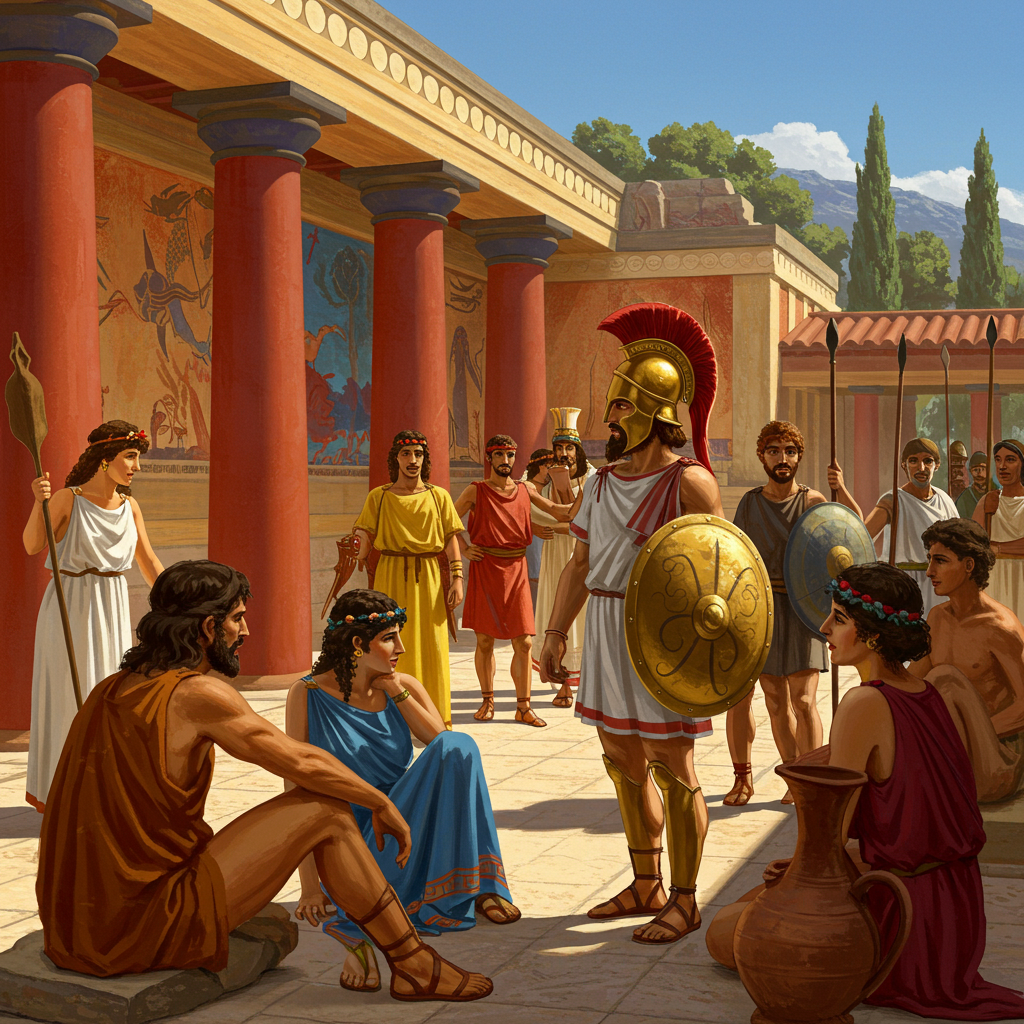
- Palatial Architecture: The most iconic site is the Palace of Knossos, a labyrinthine complex with storerooms, ceremonial spaces, and vibrant frescoes.
- Artistic Expression: Minoan art was dynamic and nature-focused, celebrating dolphins, lilies, and dancing figures.
- Maritime Trade: Minoans were skilled sailors who traded with Egypt, the Levant, and other Aegean cultures, exporting pottery, oil, and textiles.
- Religion & Rituals: Their worship involved goddesses, bull symbolism (as seen in bull-leaping scenes), and possible precursors to later Greek mythology.
Collapse: Around 1450 BCE, many Minoan sites were destroyed—likely due to natural disasters (like the Thera eruption) and increasing Mycenaean influence.
The Mycenaeans: Warriors and Empire Builders
Location & Era: Flourishing on mainland Greece from circa 1600 to 1100 BCE, the Mycenaeans took their name from their most prominent city—Mycenae.
Key Features:
- Fortified Cities: They built citadels with massive “Cyclopean” walls in Mycenae, Tiryns, and Pylos.
- Linear B Writing: Unlike the undeciphered Minoan Linear A, the Mycenaeans wrote administrative records in Linear B, an early form of Greek.
- Heroic Ideals: Their warrior culture inspired Homeric epics like The Iliad and The Odyssey—though composed centuries later.
- Gold & Grave Goods: Burials were rich with gold masks, weapons, and pottery, reflecting a hierarchical society.
Decline: Around 1100 BCE, Mycenaean civilization collapsed, possibly due to internal unrest, invasion, or broader Bronze Age disruption.
Connections and Contrasts
| Feature | Minoans | Mycenaeans |
|---|---|---|
| Geography | Crete | Mainland Greece |
| Language | Linear A (undeciphered) | Linear B (early Greek) |
| Architecture | Open palaces | Fortified citadels |
| Society Focus | Maritime & artistic | Military & hierarchical |
| Influence | Trade & aesthetics | Politics & warfare |
Legacy
Though both civilizations eventually vanished, their echoes remain vibrant:
- Mythological tales like the Minotaur and Trojan War have roots in their history.
- Greek religious practices, storytelling, and city planning bear traces of their innovations.
- Archaeology continues to reveal new insights, from underground storerooms to deciphered tablets.
The Minoans and Mycenaeans weren’t just early Greeks—they were visionaries who sculpted the Bronze Age into something brilliant and lasting.