
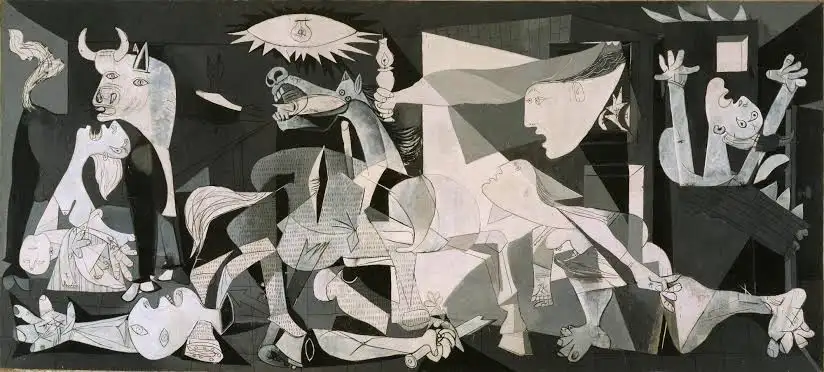
Photo/ Guernica by Pablo Picasso
Modernism was more than an art movement, it was a radical shift in the way people saw and portrayed the world. Emerging in Europe in the late 19th century and peaking through the mid-20th century, Modernism rejected classical traditions and embraced innovation. It reflected a world transformed by industrialization, war, and changing social norms.
Key Characteristics of Modernist Art
- Break from Realism: Artists moved away from lifelike representation to embrace abstraction and symbolism.
- Inner Experience and Subjectivity: Influenced by thinkers like Freud, artists explored subconscious feelings and existential themes.
- Technical Experimentation: Techniques such as collage, distorted perspectives, and unconventional materials reshaped visual language.
| Movement | Country of Origin | Key Figures | Artistic Traits |
|---|---|---|---|
| Expressionism | Germany | Edvard Munch, Wassily Kandinsky, Egon Schiele | Emotionally intense, bold, distorted forms |
| Futurism | Italy | Filippo Marinetti, Umberto Boccioni | Celebration of speed, technology, motion |
| Cubism | France/Spain | Pablo Picasso, Georges Braque | Geometric shapes, multiple perspectives |
| Dadaism | Switzerland | Marcel Duchamp, Tristan Tzara | Absurdity, chance, challenge to conventions |
| Surrealism | France | Salvador Dalí, René Magritte, André Breton | Dream-like imagery, emphasis on unconscious mind |
Architecture and Design
Modernist ideals reshaped how buildings looked and functioned. The Bauhaus movement in Germany, led by Walter Gropius, fused artistic creativity with industrial principles. The International Style emerged with clean lines, open spaces, and materials like glass and steel—creating a sleek, minimalist aesthetic across European cities.
Literature and Philosophy
In literature, Modernism reflected the complexity and fragmentation of modern life. Authors like James Joyce, Virginia Woolf, and Franz Kafka used stream-of-consciousness techniques to delve into themes of alienation, identity, and time. Philosophers such as Jean-Paul Sartre and Martin Heidegger questioned existence itself, paving the way for existentialism.
Legacy and Lasting Impact
Modernism forever changed the trajectory of European art and culture. It challenged boundaries and norms, inspired avant-garde movements, and laid the groundwork for Postmodernism. The echoes of Modernism continue today in contemporary art, design, and thought.